


Mathematics
Mathematics Curriculum Statement
Our mathematics curriculum at Gunthorpe Primary School aims to inspire both learners and staff to develop a genuine enthusiasm for mathematics, encouraging them to demonstrate and share their passion for the subject with the wider school community. We empower our teaching staff to use a variety of resources confidently to support learning and help pupils achieve mastery. Our curriculum equips learners with the mathematical knowledge and skills they need to apply, demonstrate and explain mathematical concepts across different contexts, using appropriate mathematical language and terminology.
We have adopted the Ark Maths Mastery curriculum. This curriculum is grounded in current research into effective mathematics teaching and learning, with the goal of developing pupils' conceptual understanding and skills proficiency. It is underpinned by a strong emphasis on fluency, reasoning and problem-solving. We also utilise additional mathematics support programmes, including Times Table Rockstars.
Mathematics is delivered through a Teaching for Mastery approach, with learning carefully sequenced to ensure that knowledge is retained and built upon over time. Lessons are structured in progressive small steps, enabling all children to develop deep understanding.
Core concepts are taught throughout each learning block, and all learners develop fluency in essential skills, including recalling number facts, making reasoning connections and solving mathematical problems. Central to this deep understanding is the explicit teaching of mathematical vocabulary, which is modelled by adults and then used by children to articulate their understanding. We are committed to ensuring that children recognise the importance of mathematics in the wider world and can use their mathematical skills and knowledge confidently in their daily lives. Through carefully planned cross-curricular links, children can apply their mathematical skills in meaningful contexts.
In Early Years, learners begin to develop their understanding of number by exploring their everyday environment and its mathematical significance. Carefully designed activities are provided through continuous provision to enhance children's classroom-based learning.
Mathematics is taught every day. This includes both discrete Maths Meeting sessions and a mathematics lesson. Each day, every class has a Maths Meeting, which includes a retrieval section, a times table activity with related division facts, a counting element, a telling the time activity, and solving problems mentally rather than relying on written methods. This daily practice helps learners develop fluency in mathematics.
The mathematics lesson is carefully planned to teach the next small step in learning. Maths lessons start with a 'Do Now' task, followed by teaching new content with a focus on vocabulary, where learners are exposed to mathematical structures through the Concrete, Pictorial, Abstract (CPA) approach. Once learners have been explicitly taught new concepts and had the opportunity to practise new skills, they then apply what they have learned through a talk task and develop their understanding further through independent tasks involving reasoning and problem-solving activities.
Times Tables:
Children should be practising their times tables at home to support their learning in school.
All children have a Times Tables Rockstars (TTRS) log in and can access this at school or whilst they are at home: Home - Times Tables Rock Stars
Times tables homework is set on a weekly basis for children from Year 1 onwards.
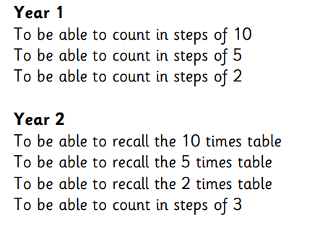
Children will be introduced to the following times tables in each year group. Children may need more time to embed times tables they have been taught previously, they will be supported in school do this.

The following websites will be useful in helping your child at home:
- www.mathszone.co.uk
- Home - Times Tables Rock Stars
- Cool online maths games for KS1, KS2, and KS3 children. - BBC Bitesize
- www.math-exercises-for-kids.com
- Learn to Count with fun Counting Games for KS1 Children (topmarks.co.uk)
Please speak to your child's class teacher if you have any queries about any aspects of Maths learning.